


Y’all, I hate this. Truly. I don’t want to be the person writing these things. But too many of us are still not prepared for what’s coming, and that’s putting you, your families, your friends, and your neighbors in at risk. We need to begin the process of learning how to protect ourselves and each other.
In May, I put out a Rapid Response episode of the Urgent Futures Podcast that generated a flurry of DMs—some supportive, some skeptical. It was called, “Why I’m Reclaiming Prepping & You Should Too.”
Why I'm Reclaiming Prepping & You Should Too | Rapid Response #8

I’ve been called a prepper more times over the past few weeks than I have in my entire life…and I want to talk about it.
Even then, what I was witnessing just in Trump’s erratic tariff policies (if we can call them policies) was enough to make me think that we needed to wake up from our comfortable collective neoliberal stupor (yes, I’m aware of privilege and that some people have had it much harder than I have; the point I’m trying to make is that, whatever your situation has been, it looks like it’s about to get a lot worse).
Cocked eyebrows be damned, I’m doubling down: you need to prepare, and you need to start right now. I’ll explain what I mean in more depth below, but as a starting explanatory note: I do not mean become a self-righteous loner survivalist. For reasons that will become obvious, I don’t believe that’s an effective long-term strategy.
All but the oldest among us (those who lived through WWII) have never known a world like the one that’s starting to emerge—one predicated on war across scales (and one that I would be thrilled to see us ward off!). This is a world where an average American can no longer just assume that the lights will come on when they flip the switch, or that there will be the food they need on grocery store shelves—or one where it will even be safe to go to the grocery store in the first place.
Over the last week, we’ve witnessed the Trump administration invade a sovereign nation and abduct its president, justified by the so-called ‘Donroe’ Doctrine, a corollary to the Monroe Doctrine that advocates for a world order based on “spheres of influence,” ditching the post-WWII world order (which, though highly problematic in its own right, did maintain a higher degree of overall global security than its replacement is poised to do). We’ve witnessed an ICE agent kill a civilian who posed no threat to him, and Vice President Vance follow up on that event by claiming the agent (who it must be said is not even a public-safety law enforcement officer) had “absolute immunity.” This is after, of course, designating essentially anyone who disagrees with them as “domestic terrorists.” Ask yourself: if ICE agents have absolute immunity, and face no consequences for their actions, what won’t they do?
There are plenty of other geopolitical alarm bells too: the warning of imminent attacks in Aleppo, the ongoing protests in Iran—which the government has responded to by shutting off the Internet, and Chinese President Xi Jinping’s New Year’s Eve proclamation that the “reunification of our motherland, a trend of the times, is unstoppable.” To name just a handful!
All these vectors point to war. For Americans, this war footing appears to apply to both foreign and domestic policy. At the risk of stating what’s blindingly obvious: war is a horror that harms (effectively) everyone. Even if you’re not in the immediate crossfire, you’ll experience the indirect consequences economically and logistically. Austerity measures, rationing, checkpoints, surveillance, and more.
If you’re an American reading this, what I assume is most palpable for you right now is the prospect of civil conflict—that the Trump administration has amassed an extrajudicial army/police force that can operate with impunity. I hope that I can look back at that sentence and say, “Phew! Near miss.” But for now, we have to base our hypothesis at what’s actually happening. If you’re banking on making change at the midterms, please understand: the current likelihood that there will be a “free and fair” midterm election is low. Not impossible, but low. To be clear: I’m not saying not to vote. But don’t let that be the only thing you do or plan for. The administration is not acting like it ever intends to be out of power, and we need to believe what their actions are telling us.
What You Can Do About It
A lot of this is out of our control. Your job now is to identify what is in your control and just begin. Building resilience is a long game; even if you feel crunched, move at human speeds. Frenzied activity without strategy isn’t likely to be much help.
Here’s where I explain what I mean when I say we need to become preppers.
In Dr. Chris Ellis’s must-read Resilient Citizens, he breaks down five archetypes of “resilient citizens.” You can grasp the nuances among the five groups in the chart below. For a full breakdown of each, you need to just read the book (and I’ll link to my podcast conversation with him here once it’s live).
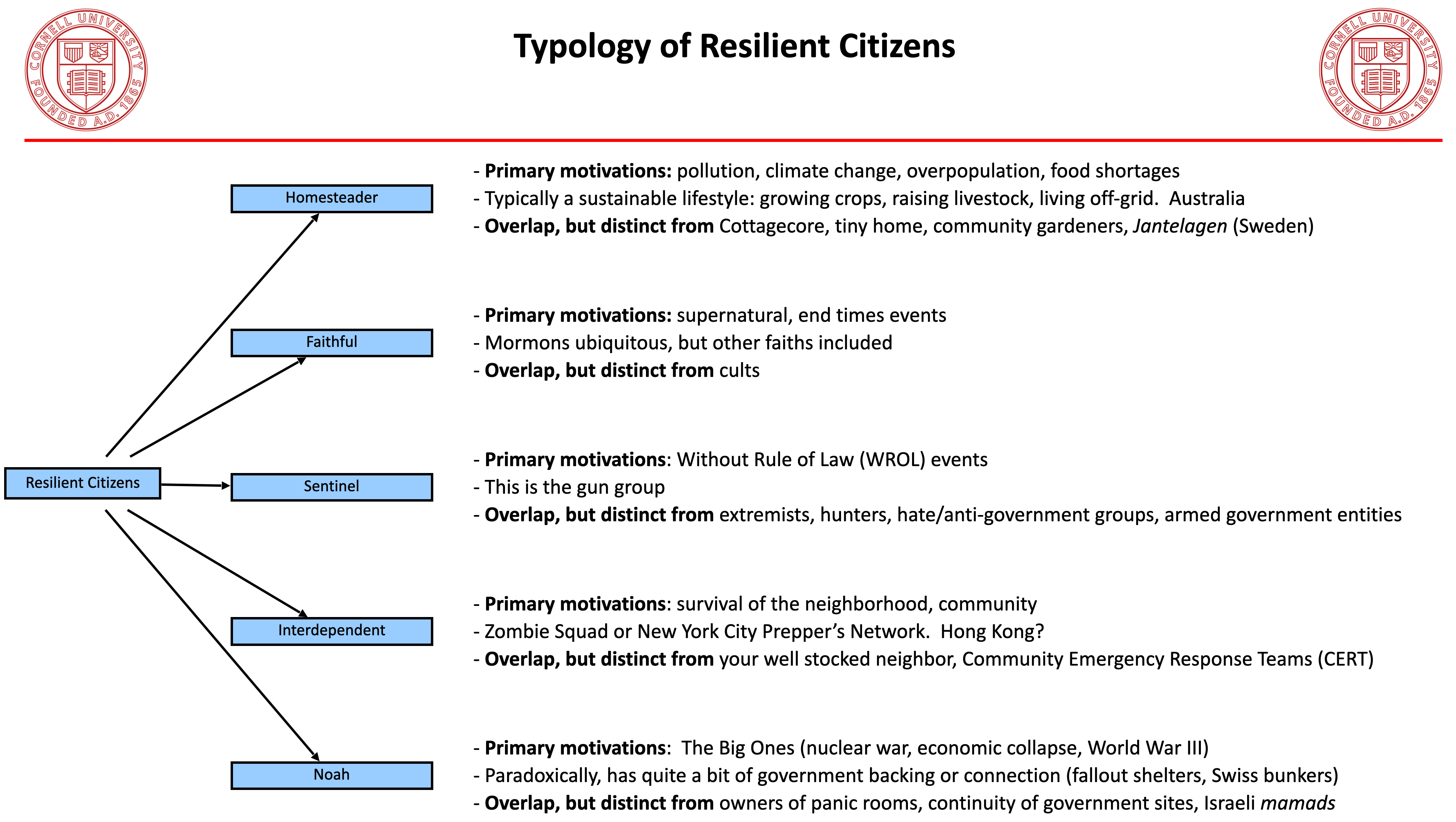
I want to draw your attention to the “Interdependent” category. This is the category I believe is truly the most resilient among the five (though of course each has relative strengths). Interdependents are those who recognize that what has helped our species succeed evolutionarily is our unusual capacity to cooperate, even with strangers.
Interdependents don’t squirrel off in bunkers and hoard resources, they organize and work together to weather cataclysm. They take stock of their collective resources and capacities—maybe you’re an amazing seamster, maybe your neighbor knows how to make the best use of finite garden space to grow hardy local plants, maybe your other neighbor knows first aid, maybe another has spent time developing self-defense skills, and maybe that friend down the street has been developing anti-surveillance apparel. And yes, maybe another neighbor has seemed like a little bit of a weirdo, banking water (2 gal/person/day), food (canned goods, salt/spices, 25lb bags of rice, etc.), and key cleaning supplies. None of us is going to be fully prepared in our own right, but together our odds jump up a whole lot.
I’m going to be writing a lot more about this in the weeks to come, but for now, I just need to say this: start talking to your neighbors and friends. This is the absolute first step in the process to building collective resilience together. With a shared baseline and open lines of communication, you’ll be able to start making more fine-grained decisions about resources, skills, education, action plans, et al.
My invitation to you: don’t be afraid to sound alarmist—the times are alarming. These conversations will help you understand who has your back, and give you a chance to let others know that you have theirs. If disaster really does hit, our best chance to make it through is to do so together.
For now, this is still a relatively easy thing to do—it’ll get harder if paranoia heightens and martial law is instituted. I hope to God that those things don’t happen; I take no pleasure in saying any of this. But better to be prepared and seem a little alarmist than to find yourself imperiled.
Stay safe out there.
Thinking about building local resilience I've switched from shopping at big chains like Whole foods and Amazon to a local food cooperative and continue to support our CSA. Where we shop also shapes the kind of world we build.
If anyone needs help and a plan and encouragement for building community in your neighborhood (which can be scary without support), Graham McBain at Hey Neighbor Labs hosts weekly calls and a group chat guided by a ten step plan.