


Amid videos of ICE brutality, news about protests in Iran, and fear that the Trump administration is going to torpedo NATO by invading Greenland (and set off a chain reaction of astounding bad news in the process), I’ve encountered more and more people in my life posting photos of themselves from a decade ago. We’re talking the works: stylized, blown-out Instagram and faux-film VSCO filters, flower crowns, skinny jeans, and other signifiers of (what we now call) Millennial cringe. Captions overflow with a mix of nostalgia and laughter at past selves.
Indeed, two weeks into a bonkers 2026 and the biggest trend on social media is…reversion. Maybe it’s only or primarily Millennials doing this—my perspective is inevitably blinkered given that I am one—but it’s pervasive enough that I’ve been thinking through what this trend tells us, not only about 2016 but about the current moment.
Surface aesthetics are doing what social media does best: compressing the zeitgeist into digestible formats. The throwback is more than just “lol skinny jeans,” it’s a collective attempt to renegotiate what the last decade did to us—and the uncertainty so many of us are feeling as we tentatively look toward the next decade through the cracks in our fingers.
2016 and the ‘Great Weirding’
Perhaps the primary reason 2016 feels so magnetically nostalgized is that it was a watershed political year, embodied foremost in the two prongs of Donald Trump’s election in the U.S. and the Brexit referendum in the U.K. However much the comfortable post-Recession neoliberalism might have cradled the collective consciousness (at least in the Global North) on January 1, 2016 had been definitively obliterated by December 31, 2016. Reviewing the current state of nationalist, authoritarian politics and hate-driven social ideologies, 2016 stands out as a decisive first chapter. Sure, there were precursors—when we smash the rewind button, we scrub past Gamergate (2014), the corporate and big-bank bailouts of the Emergency Economic Stabilization Act (2008), and the PATRIOT Act (2001), to name just a few of the many early alarms—but 2016 is when the threads twined into something we can call a paradigm.
Though it played out in the political arena, this rupture was epistemic and ontological. Before 2016, many people still assumed that political and cultural change would be incremental, predictable, and legible. After it, the sense that institutions were stable, that shared narratives still mattered—or even existed—had begun its irreversible erosion. History, which had supposedly “ended” in 1989, was rearing its wild head anew.
So when I see friends share decade-old photos or celebrate the aesthetics of a “simpler” Internet, what I feel smuggled in with it is a desperate grasping for a version of the world that held the last glimmers of a legible reality, before macro-scale volatility became a persistent feature of our lives (again, this operates on scales—many had been living under fractured, oppressive realities all throughout these supposed “good” times). In this sense, 2016 becomes less about chokers and more about its role as a macro-cultural hinge, the moment when the structuring logics of the world irrevocably cracked.
I’m certainly not the first to identify this phenomenon. Perhaps the most salient framing I could point you to is Venkatesh Rao’s notion of the “Great Weirding.” He writes:
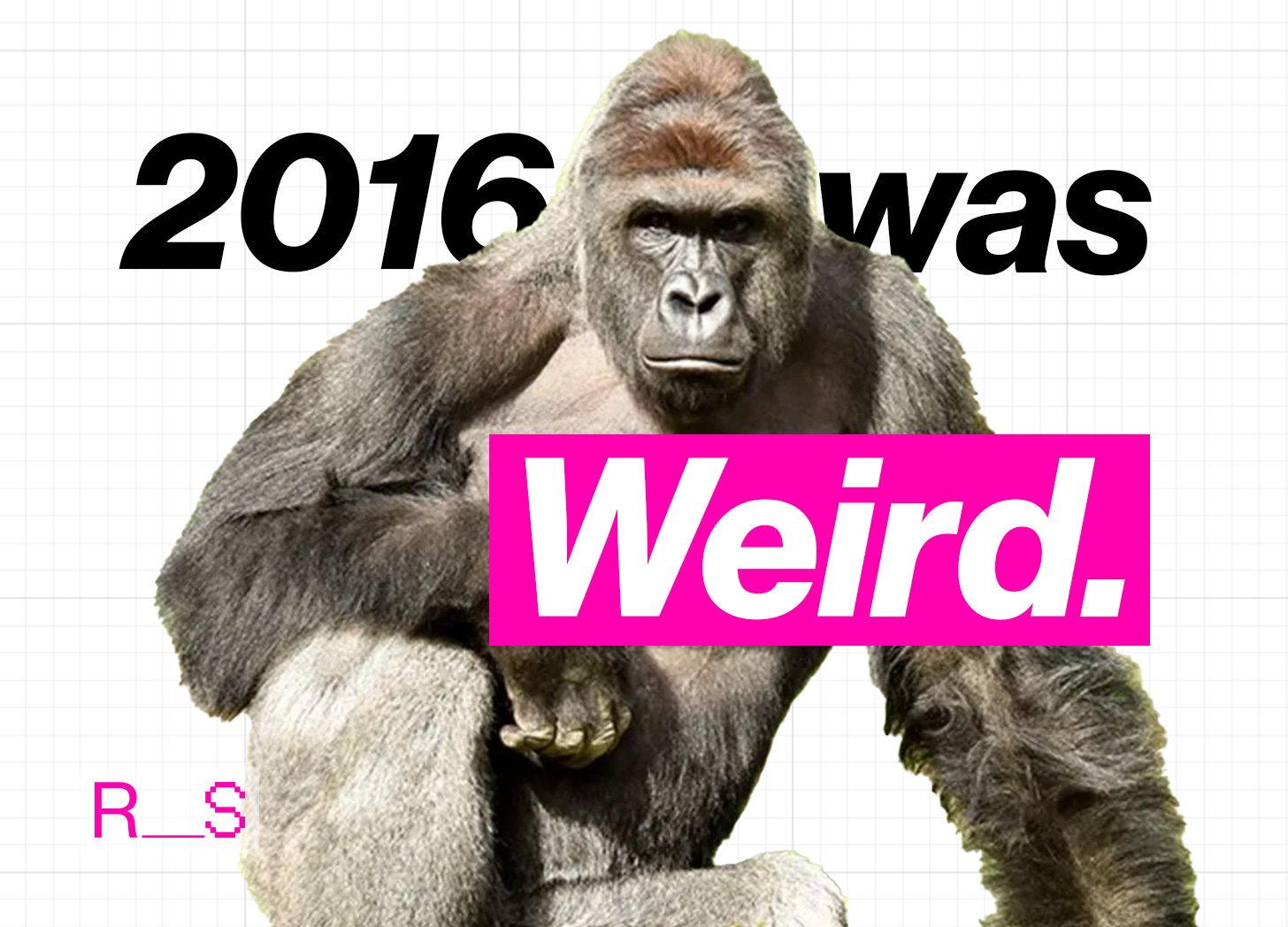
For many, the four-year period between 2016 and 2020 has seemed like a relentless parade of decade-sized weeks. I call this period The Great Weirding, a phrase I first used in a 2016 essay reflecting on the significance of the Harambe meme, which emerged in the wake of the unsettling killing of Harambe, the gorilla, at the Cincinnati Zoo in May, 2016. It was an event which, for many of us, turned into the symbolic marker of the advent of the Great Weirding.
and
It is a world that many saw coming, but almost nobody saw coming quite this fast. Starting in 2016, the future I wrote about in 2015, and expected to arrive by perhaps 2030 (see The Future in the Rearview Mirror) arrived so rapidly that it has left much of the world shell-shocked and bewildered. Not only did it arrive more rapidly than any of us expected, it arrived in a form that confirmed many of the worst fears, rather than the best hopes, of 2015. Humanity as a whole appeared to collectively abandon its fragile faith in the mechanisms — liberal democracy, free markets, and a globalized economic order — to which the great global increases in prosperity over the previous thirty years had been provisionally attributed. And as faith in the mechanisms unraveled, so did the widespread consensus that prosperity did, in fact, increase over that period.
For my part, I’ve analyzed these phenomena through the lens of what I call “Postreality,” though I chart the origins of this reality paradigm to the immediate aftermath of WWII. You can read more about my usage here. I’ve also elaborated on how this has impacted the evolution of fascism in my notion of “quantum fascism.”
Welcome to Quantum Fascism: American Authoritarianism Under Donald Trump

I first started noodling on this post in February. The official White House X account had just posted a 41-second video titled, “ASMR: Illegal Alien Deportation Flight.” Remember it? In the interminable dog years of Trump’s muzzle-velocity presidency, it genuinely feels like a lifetime ago.
With all that in mind, these posts exhibit a nostalgia for a time when our expectations felt aligned with practical reality. And because 2016 is also the year that I’d argue the trappings of what we now call “Millennial cringe” peaked, many people have these visible shared reference points to reflect on the moment just before the Great Weirding got going in earnest.
We Miss “Relationship Feeds”—And What They Stood For
Underneath the eyeliner and memes is a quieter sociotechnical grievance, which has to do with how social media has evolved. We miss the era when platforms felt personal and less predatory. While surveillance capitalism was fully underway by 2016, many of us didn’t quite realize the scope, and moreover, whatever was afoot in 2016 pales in comparison to the algorithmic panopticon we now inhabit.
If you’re liking this article, you might appreciate my recent conversation with Nina Jankowicz, who runs the fantastic publication The Wayfinder:
Speaking for myself, I miss how “old” Facebook used to feel, blending aspects of microblogging and forums, with folks you actually knew. You weren’t broadcasting the way you are being forced to today, you were chatting with folks in your virtual neighborhood.
The 2016 trend romanticizes this older relationship to attention. We’re mourning the loss of an internet that felt less curated, commercialized, and saturated with constant ambient global crisis. Ironically, there’s no small amount of retconning going on in this approach to 2016—at the time, many referred to it as the “worst year ever,” but, to quote the meme, it turned out to only be the worst year so far.
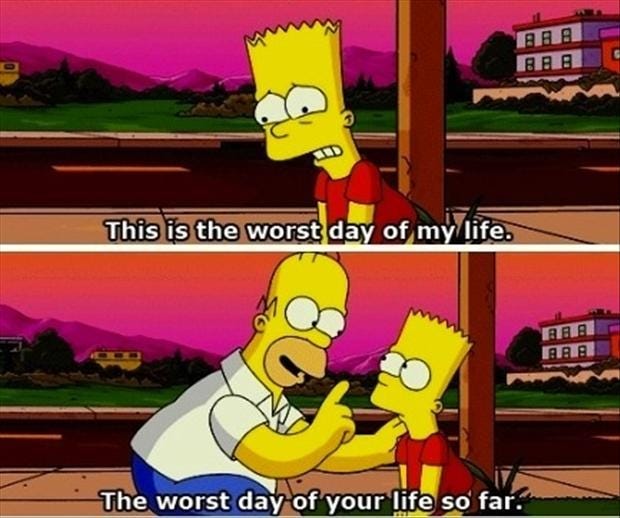
Ultimately, 2016 is a potent container for this particular flavor of pre-Weirding nostalgia because it’s close enough to feel intimate and personally retrievable (via your camera roll, feeds, and story archive), but distant enough to benefit from “good ole days” mythologizing. It’s the last year many of us can point to and say, “I had no idea what was coming.” So when I see people post 2016 pictures in 2026, I don’t just see them saying “look how young/goofy/cringe/etc. I was”—I see them saying: “This was the last version of me who didn’t live in the permaweird.”
Here are some recent posts that you might like if you appreciated this one:
Is OpenAI Hellbent on Destruction? On the Privacy, Security, & Sociopolitical Nightmares of Atlas Browser & Sora 2

It’s always worth checking yourself when you feel a sense of doom. As Panic! At the Disco reminds us, “It’s much better to face these kinds of things with a sense of poise and rationality.” Are your concerns founded? Are they priorities (because boy-o, we don’t lack
Protecting Your Mental Health & Emotional Wellbeing Amid Polycrisis, Responding to ICE, 'Bullying Bari Weiss,' & The Futures of Journalism - Anya Kamenetz | Rapid Response #14

Welcome to the Urgent Futures podcast, the show that finds {signals} in the noise. Each week, I sit down with leading thinkers whose research, concepts, and questions clarify the chaos, from culture to the cosmos.
What is Accelerationism? A Primer on the Defining Philosophy of Our Time, Including Effective Accelerationism (e/acc), the Dark Enlightenment, & More

You may have seen accelerationism coming up more in the news. Or, if you’ve followed Reality Studies and/or Urgent Futures for a while, you’ve perhaps encountered it here. But I realized I’d never done a proper explainer on what accelerationism is, so, following in the vein of my
Excellent piece, totally accurate. Thank you for this perspective. It actually helps to think about my past through this lens. It’s like we are in a parallel universe, and 2016 is when we got bumped into the one we are in.
2016 was absolutely the year weventured off into an alternate reality. My American brothers fled Trump 1.0. The final undue optimism of neoliberalism evaporated. A Dane wrote an excellent book titled “Once, we believed in a future.”
Civilisation is cresting and some of us see the coming plunge. By all accounts we should be enjoying peak prosperity, but the yawning abyss is mezmerizing and breathtaking in the most horrific way imaginable.